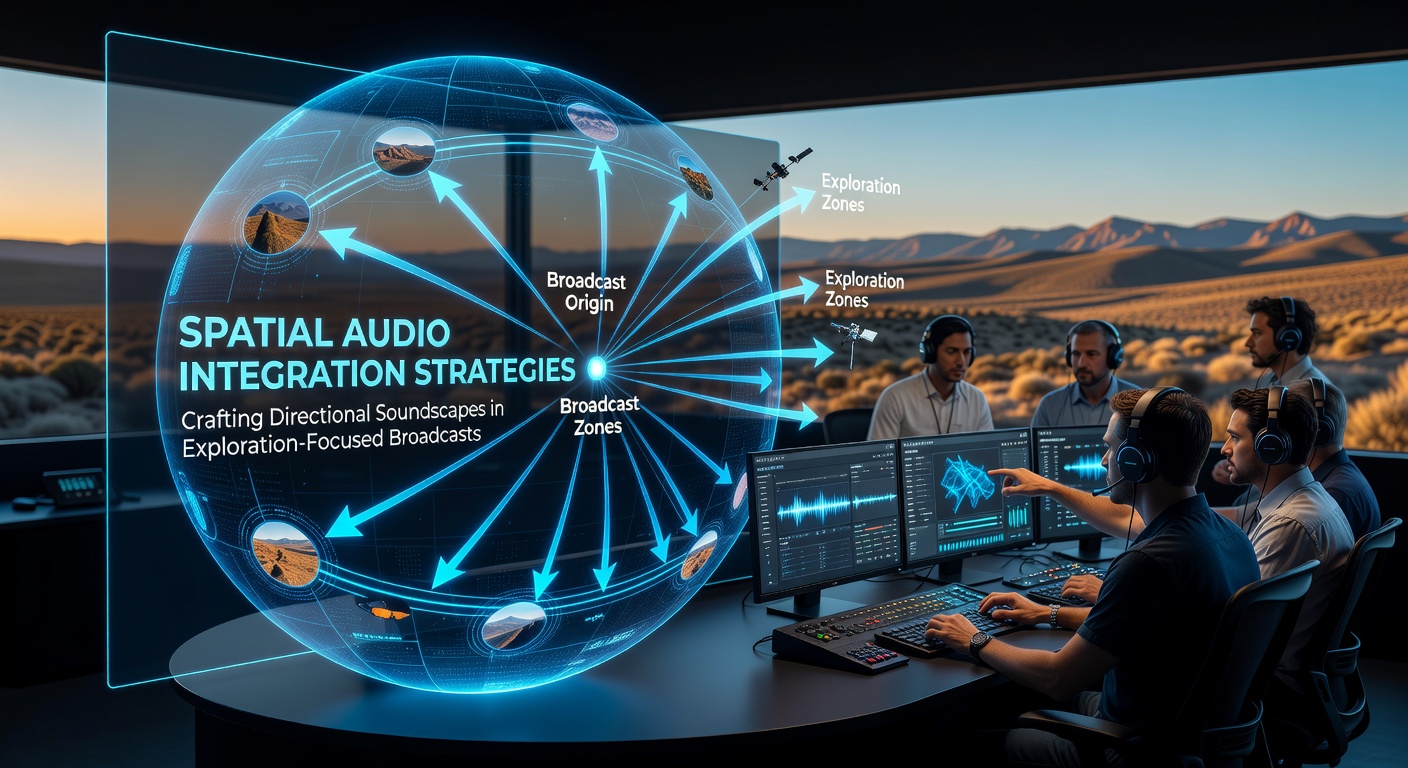
Spatial Audio Integration Strategies for Crafting Directional Soundscapes in Exploration-Focused Broadcasts
Exploration-focused broadcasts rely on precise audio placement to guide viewers through virtual environments while maintaining immersion across extended sessions, and spatial audio techniques have become central to this process since platforms expanded support for object-based mixing in recent years.
Developers and broadcasters integrate tools like Dolby Atmos alongside game engines such as Unity and Unreal to position sounds dynamically based on player movement and environmental cues, which allows directional elements like distant echoes or layered ambient tracks to shift in real time during live streams.
Core Technical Foundations
Hardware requirements include compatible headsets and sound cards that support binaural rendering, whereas software layers handle encoding for multiple output formats so that both stereo listeners and those using surround setups receive consistent spatial information without manual adjustments mid-broadcast.
Studies from institutions including the Audio Engineering Society show that integration begins with mapping game audio channels to spatial objects, then calibrating these objects against broadcast software such as OBS Studio or Streamlabs to preserve directionality even when compression occurs during transmission.
Engineers often route auxiliary channels through virtual surround processors before they reach the encoder, and this workflow prevents phase issues that could collapse the soundscape into a flat mix when viewers tune in from varied devices.
Implementation in Exploration Genres
Games centered on discovery benefit when footsteps, wind, and hidden object cues receive prioritized spatial treatment, because these elements help audiences anticipate pathways and secrets without relying solely on visual overlays that might clutter the frame.
Broadcasters achieve this by creating layered profiles in their DAWs that assign priority levels to environmental sounds, then automate panning parameters to follow on-screen character motion while reserving headroom for sudden directional events like enemy approaches from off-camera angles.
Data from platform analytics released in early 2025 indicated that streams employing these layered profiles maintained higher average watch times in open-world titles compared with standard stereo mixes, although exact figures vary by game genre and audience demographics.
Viewer Accessibility Considerations
Accessibility guidelines from organizations such as the International Game Developers Association recommend providing toggle options so that viewers can switch between full spatial rendering and simplified stereo versions when device limitations or personal preferences require it.
Subtitles and visual radar indicators often accompany spatial audio in exploration broadcasts to ensure directional information reaches those without compatible playback hardware, and broadcasters test these combinations during pre-stream rehearsals to avoid synchronization drift.
Latency remains a persistent factor when spatial processing occurs on the broadcaster side, yet many mitigate this through dedicated audio PCs that handle rendering separately from the main game capture pipeline.
Platform-Specific Adjustments Through 2026
Streaming services continue to refine their audio pipelines, and in May 2026 several major platforms introduced native support for higher-order ambisonics within their mobile applications, which expanded the reach of directional soundscapes to handheld viewers without requiring additional apps or plugins.
Broadcasters who prepare alternate mixes ahead of these updates can deliver consistent experiences across desktop, console, and mobile audiences, whereas those relying on legacy stereo feeds may notice reduced engagement when directional cues become standard expectations.
Research published through IEEE conferences has tracked how these platform changes affect production workflows, revealing that teams adopting modular audio graphs can adapt to new encoding standards within hours rather than days.
Practical Workflow Examples
One production group handling long-form exploration streams separates dialogue, music, and environmental stems early in the chain, then applies object-based positioning only to the environmental stem so that narrative elements stay anchored while the surrounding soundscape moves freely with camera and character positions.
They monitor output through multiple listening stations during test broadcasts to confirm that subtle cues such as water flow or wind direction translate accurately, and they adjust object radii based on viewer feedback collected through chat polls.
Another approach involves scripting automation within the streaming software that triggers preset spatial configurations when specific in-game locations load, which reduces manual intervention during high-tension exploration segments.
Conclusion
Spatial audio integration in exploration-focused broadcasts continues to evolve alongside platform capabilities and game engine advancements, with successful implementations depending on careful channel mapping, hardware calibration, and accessibility planning that together preserve directional intent across diverse viewer setups.
Those preparing for future updates benefit from maintaining flexible mixing templates that accommodate both current stereo delivery and emerging ambisonic formats without requiring complete workflow overhauls.