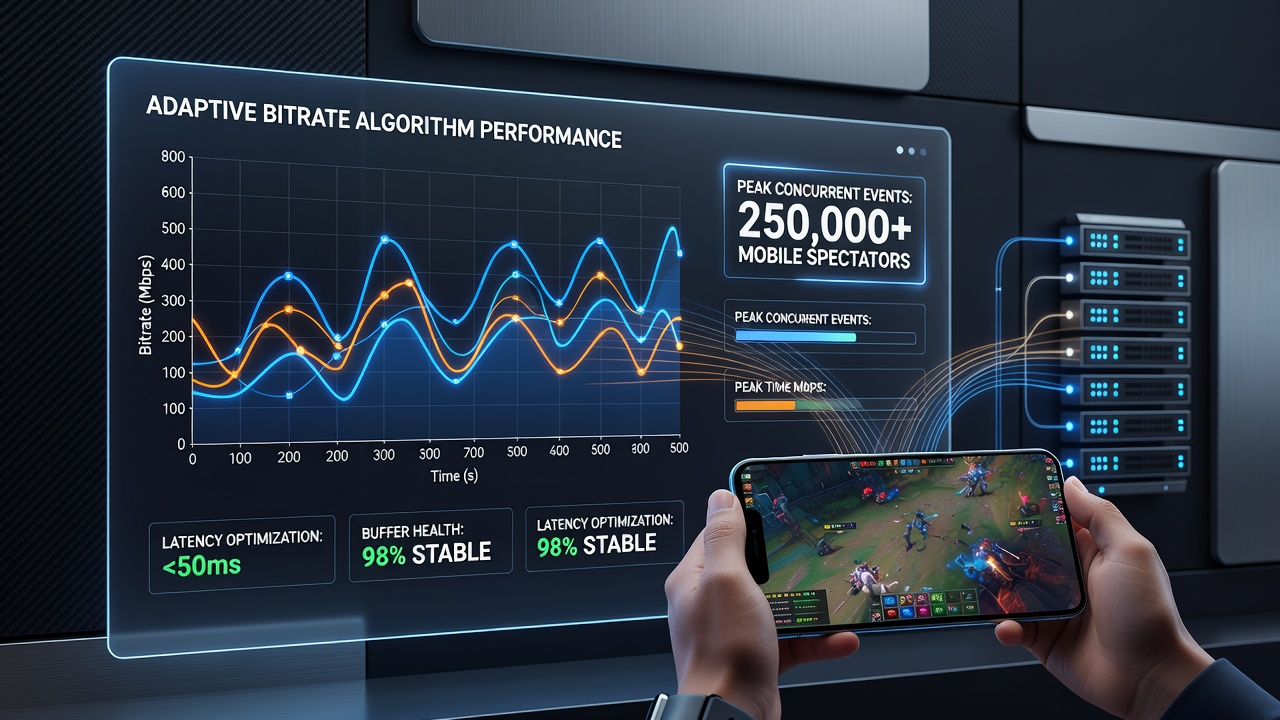
Adaptive Bitrate Strategies Enhancing Mobile Esports Spectator Experiences During Peak Concurrency Periods
Adaptive bitrate algorithms adjust video quality in real time based on available network conditions, and these systems play a central role in delivering stable streams to mobile esports audiences when viewer numbers spike simultaneously. During major tournaments mobile networks face concentrated demand that can fluctuate within seconds, which forces platforms to rely on algorithms capable of predicting and responding to bandwidth shifts without interrupting playback. Researchers at institutions such as the Massachusetts Institute of Technology have documented how standard ABR methods often fall short when thousands of mobile devices connect to the same cell towers at once, leading developers to create specialized variants that factor in device movement, battery state, and regional congestion patterns.
Core Mechanics of Tailored ABR for Mobile Esports
Traditional ABR approaches measure throughput and buffer occupancy to select the next segment, yet mobile esports viewers encounter additional variables including rapid handoffs between 5G and 4G cells plus variable latency from spectator chat overlays. Engineers integrate machine learning models that analyze historical traffic from past events to forecast congestion spikes, allowing the algorithm to lower resolution preemptively rather than reactively. One study released by the European Telecommunications Standards Institute examined data from several international competitions and found that predictive ABR reduced rebuffering events by up to 37 percent compared with reactive baselines during the opening minutes of finals matches.
These specialized algorithms also monitor device-specific metrics such as screen size, processor load, and remaining battery percentage, then adjust encoding ladders accordingly so that lower-powered phones receive lighter streams while flagship devices maintain higher fidelity. Observers note that this multi-factor decision process requires constant communication between the client application and edge servers positioned near major population centers, which shortens the feedback loop and keeps quality switches imperceptible to viewers.
Handling Peak Loads in August 2026 Tournament Windows
August 2026 brings several overlapping esports calendars that concentrate mobile traffic in short windows, particularly across Asia-Pacific and European markets where evening schedules align across time zones. Network operators report that simultaneous viewership can exceed baseline levels by factors of eight to twelve during championship deciders, placing stress on both radio access networks and content delivery infrastructure. Algorithms tuned for these conditions incorporate live telemetry from mobile carriers to detect when cell sectors approach capacity thresholds, then trigger coordinated quality reductions across clusters of users rather than handling each stream independently.
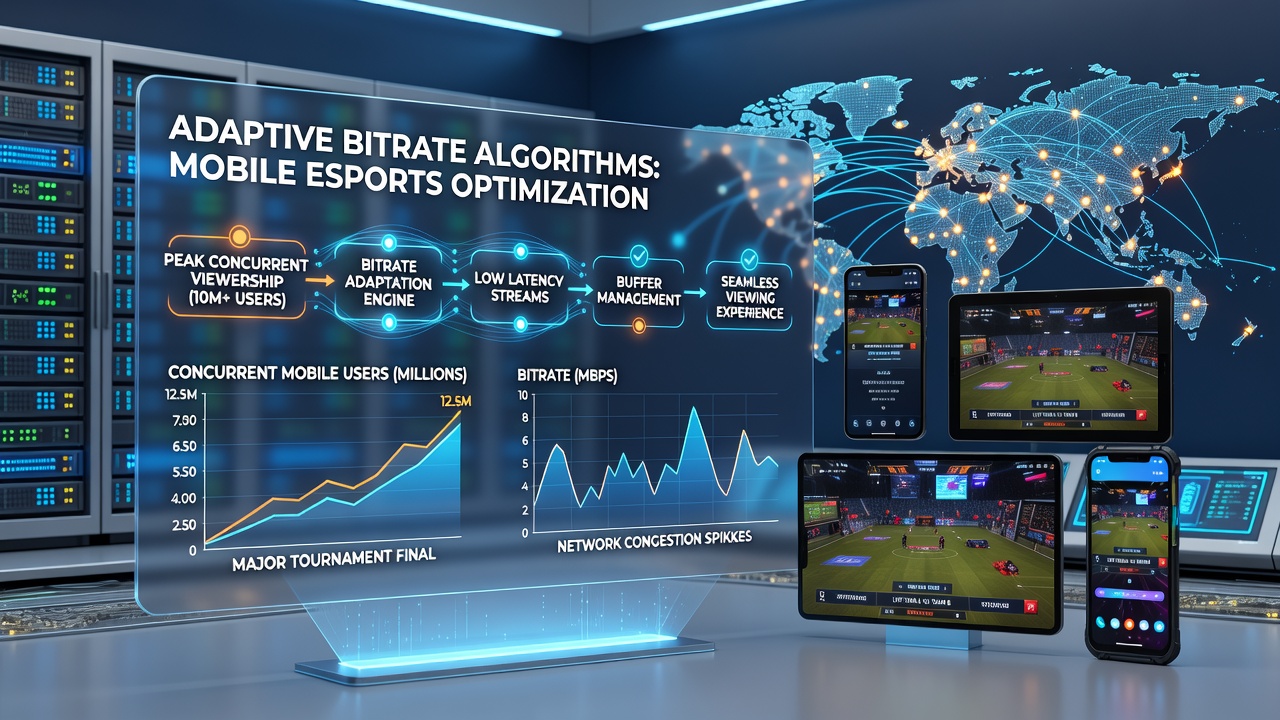
Case examples from prior seasons show that hybrid ABR systems combining client-side prediction with server-side orchestration maintain higher average bitrates across the audience even as total concurrent connections climb. Data collected by the International Telecommunication Union during comparable high-density periods indicates that regions deploying these coordinated models experienced fewer quality complaints logged through official regulatory channels than areas relying on unmodified open-source ABR libraries.
Integration With Mobile Network Infrastructure
Collaboration between streaming platforms and mobile operators has produced APIs that expose real-time radio conditions directly to ABR decision engines, enabling finer control over segment selection. In practice an algorithm might receive a signal that a particular tower is experiencing uplink congestion, then instruct nearby clients to request smaller video chunks encoded at lower frame rates while preserving audio clarity for commentary. Such integrations have been tested in controlled trials across Canadian and Australian networks, where regulators documented measurable improvements in stream continuity metrics during simulated peak events.
Security considerations also influence algorithm design because malicious traffic patterns can mimic legitimate surges, prompting the inclusion of anomaly detection layers that differentiate between organic viewer growth and distributed denial attempts. These safeguards operate alongside core bitrate logic without introducing noticeable overhead on mobile processors.
Performance Metrics and Ongoing Refinements
Key performance indicators tracked by developers include time to first frame, rebuffering ratio, and average selected bitrate normalized by device category. Reports compiled by academic teams at several universities show that tailored ABR implementations consistently outperform generic solutions once concurrent mobile spectators surpass roughly 150,000 within a metropolitan area. Continuous refinement cycles incorporate fresh telemetry from each major event, allowing models to account for new variables such as the increased adoption of dual-SIM devices and the rollout of additional mid-band spectrum allocations.
Conclusion
Adaptive bitrate algorithms customized for mobile esports spectators during peak concurrent events represent a convergence of network engineering, device awareness, and predictive analytics that together sustain viewing quality under extreme load. As tournament schedules intensify in periods such as August 2026, the continued evolution of these systems depends on expanded data sharing between platforms, carriers, and standards organizations across multiple regions. Observers tracking adoption rates note steady integration of these techniques into major streaming services, driven by measurable reductions in viewer drop-off during high-stakes moments.